

 IT
IT  DE
DE 
D-mannose is the ideal natural remedy for preventing and treating acute and chronic Cystitis.
- What is D-mannose and how does it work?
- How to take D-mannose
- Side effects of D-mannose
- Who can take D-mannose?
- Where to buy pure D-mannose
D-mannose
What is D-mannose and how does it work?

D-mannose is a simple sugar extracted from the bark of trees such as birch. It has a high affinity for the “legs” (lectins) of mannose-sensitive bacteria (Escherichia coli in particular, but not exclusively).
D-mannose attaches itself to bacterial lectins, which, once covered by this sugar, are no longer able to adhere to the bladder. These bacteria therefore remain free in the urine and are eliminated during the first urination, thus preventing bacterial Cystitis.
In-depth analysis: What is D-mannose and how does it work?
Taking D-mannose
How is D-mannose taken?
The dosage of D-mannose varies depending on the purpose for which you are taking it: to combat acute Cystitis or to prevent an acute attack.
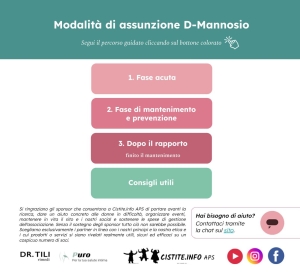
In the acute phase, you should take a dose of 1 gram of pure D-mannose every 2-3 hours for a total of 6-7 doses per day for the first 3 days, gradually reducing the dose in the following days if the symptoms subside.
During the maintenance phase, take 3 doses of 1 g of D-mannose per day: morning, afternoon and evening (before going to bed) for at least one month. After that, you can gradually reduce the daily dose.
D-mannose can also be used for vaginal douches and urethral washes.
Cistite.info APS has developed these specific treatment plans for each type of cystitis. The plans can be received immediately and free of charge by email.
| Available treatment plans | Download the treatment plan |
|---|---|
Intake of D-mannose | |
Post-coital Cystitis |
|
Chronic Cystitis |
|
Acute Cystitis |
|
Cystitis in children |
|
Aseptic Cystitis |
|
Asymptomatic bacteriuria |
|
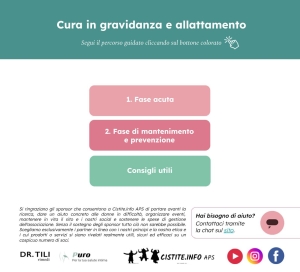
Cystitis during pregnancy and breastfeeding |
|
Thrush and vaginal infections |
|
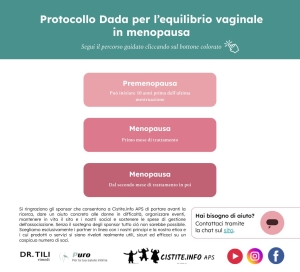
Cystitis during menopause |
|
 Receive a free treatment plan for chronic Cystitis
 Receive a free treatment plan for acute Cystitis
Further information: Hot to take D-mannose
Side effects
Does D-mannose have any side effects?
 It is a harmless sugar, that causes very few and insignificant side effects. Most of the side effects reported concern the intestinal tract: bloating and (more rarely) diarrhoea, which tend to disappear after the first few days of use.
Further information: side effects of D-mannose
Who can take D-mannose?
 As D-mannose is a harmless sugar, it can also be taken by people with diabetes, infants, children, pregnant women and breastfeeding mothers. D-mannose has no contraceptive effects and can therefore also be taken by those who wish to become pregnant.
Further information: D-mannose in children, D-mannose and diabetes, D-mannose during pregnancy and breastfeeding
Where can I buy it?
 Thanks to twenty years of experience working with women affected by urogenital disorders and close collaboration with numerous healthcare professionals and Farmacia Tili, the association Cistite.info APS has developed the Puro line for the well-being and balance of the urogenital tract.
This line includes Puroman, a supplement based on pure D-mannose only, free from excipients, preservatives, binding agents, heavy metals, contaminants, pesticides, solvents, hydrocarbons, allergens, sulphur dioxide, sulphites, colourings, flavourings, allergens and artificial sweeteners. The D-mannose used in Puroman has not been irradiated or ionised and is not derived from GMO or endangered plants.
It is therefore suitable for children, pregnant or breastfeeding women, diabetics, coeliacs and vegans.
Our association has entered into an agreement with Tili Pharmacy, which offers our members a 20% discount. It also offers courses and activities designes to alleviate the discomfort and pain caused by vaginal infections.
Further information: Agreement with Tili pharmacy
Benefits: Agreements for members
Bibliography
- “Factors which influence colonization by uropathogenic bacteria "4th International Symposium, Perspectives in Clinical Microbiology and Infections", Venice 2003
- “L’intolleranza ai disaccaridi”, Montalto, Santoro, D’Onofrio, Curigliano, Gallo, Visca, Cammarota, Gasbarrini, Gasbarrini, Istituto di Medicina interna, Università Cattolica del Sacro Cuore, Roma. Da “Medici oggi”, anno XI, n°4, Maggio 2007
- “Advances in microbial physiology", Anthony H. Rose, Volume 28, accademic press inc 1987, pag 100
- "Alternative medicine and spinal cord injury: beyond the banks of the mainstream", Laurance Johnston, Demos Medical Publishing, Inc. 2006, pag 167
- “Women's Encyclopedia of Natural Medicine", Tori Hudson, McGraw-Hill 2008, pag 70
- "Effect of D-mannose and D-glucose on Escherichia coli bacteriuria in rats", Michaels E, Chmiel J, Plotkin B, Schaeffer A., Urol Res. 1983;11:97-102
- http://www.waterfall-d-mannose.com
- “Carbohydrates as future anti-adhesion drugs for infectious diseases”, Nathan Sharon, Department of Biological Chemistry, The Weizmann Institute of Science, Rehovot 76100, Israel, Biochimica et Biophysica Acta 1760 (2006) 527–537, Elsevier, 2006
- “Synthetic Multimeric Heptyl Mannosides as Potent antiadhesives of uropathogenic escherichia coli” ChemMedChem 2009, 4, 749 – 755